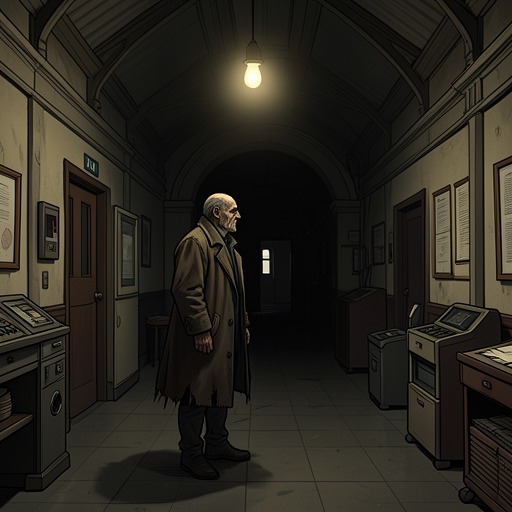
Patrick Bateman
American PsychoPatrick Bateman is the central consciousness and most consequential unreliability in the novel. He moves through Wall Street, expensive restaurants, apartments, offices, clubs, and the streets of Manhattan as if social life were a sequence of rehearsed displays, yet the display repeatedly fractures into cruelty, hallucination, bodily compulsion, and identity confusion. His first-person account makes him both protagonist and problem: the reader receives his perceptions directly while being denied any stable guarantee that what he describes has occurred as he says it has.
Identity and Social Persona
Patrick Bateman presents himself as a young, affluent professional associated with Pierce & Pierce. In Timothy Price's account, the men around him are competitive, highly paid, and dissatisfied, and Patrick belongs effortlessly to this world of corporate ambition, luxury consumption, and status anxiety. His environment is defined by Wall Street offices, exclusive restaurants, designer clothing, expensive drinks, business cards, credit cards, and constant comparison. The social identity is less an inner self than a collection of recognizable signals.
His attention to clothing and grooming turns appearance into a daily discipline. At Courtney Lawrence's brownstone, he wears a black wool Giorgio Armani overcoat and participates in the carefully choreographed exchange of air kisses, while the room is accompanied by the new Talking Heads CD. At dinner he is irritated by the arrangement of people, clothes, fragrances, and service, and he counts the various silk ties and brands until their perfumes become, in his description, a cold and sickening mixture. The detail is not incidental: Patrick reads people through labels and surfaces because surfaces are the principal language his world permits.
Objects serve the same function. At a restaurant he removes a new business card from an $850 gazelleskin wallet bought at Barney's and places it on the table, waiting proudly for the others' reaction. At Pastels, a $475 bill is charged to his platinum American Express card while he collects the others' cash. His competence is therefore inseparable from display. He can manage a transaction, perform indifference, and maintain the etiquette of privilege, but the performance also exposes his dependence on recognition from men who are themselves difficult to distinguish.
Interior Life and Fragmented Routine
Patrick's private life does not provide a stable contrast with his public persona. Returning to his apartment after an evening out, he greets a doorman he does not recognize, enters a living room high above the city, and masturbates while moving mentally among Evelyn Richards, Courtney Lawrence, Vanden, and a Calvin Klein model seen in an advertisement. The sequence joins desire to advertising and to repetition; even solitude is populated by names, bodies, and images already processed by consumer culture. His orgasm is weak, and the episode ends not in intimacy but in another borrowed image.
His apartment is presented with the same cataloguing intensity as his clothing. A David Onica painting of a naked woman watching MTV, set against a Martian landscape scattered with dead fish and smashed plates, hangs above a white marble and granite fireplace. A Toshiba digital television and a Wurlitzer 1015 jukebox complete the room's technological and decorative order, although Patrick judges the jukebox against the harder-to-find Wurlitzer 850. The room appears controlled and expensive, but its imagery is already violent and estranged. The polished domestic setting becomes an extension of Patrick's mind: ordered by acquisition, saturated with spectacle, and unable to produce comfort.
Music repeatedly gives form to his unstable consciousness. His discussion of Genesis praises the movement from the group's earlier, more intellectual work toward the modern pop accessibility he associates with Duke and Phil Collins. This preference echoes Patrick's larger attachment to surfaces that are immediate, polished, and commercially legible. Elsewhere, songs drift through scenes as though the culture surrounding him were supplying a ready-made emotional vocabulary that he cannot generate himself.
Escalation and Violent Impulse
Patrick's impulses become increasingly difficult to contain. After a conversation with Jean, in which he is unable to manage ordinary plans or even the instruction to say no, he throws a cheap Walkman into a trash can because it feels like a boulder around his throat. He then suffers violent abdominal cramps, sweats, foams at the mouth, shoplifts a canned ham, vomits it, and wanders through Manhattan in a delirious state. During the same episode he buys butcher knives, an axe, hydrochloric acid, a Habitrail, and two white rats, intending to torture the animals, though he later leaves the package behind.
The episode is marked by uncertainty even within Patrick's own narration. He cannot remember whether he finally bought the teapot he had intended to purchase, and he cannot maintain a consistent account of his movements. His compulsive acts are interrupted by consumer errands, music, advertisements, and encounters with strangers, so that violence and shopping occupy the same narrative register. The result is not merely a portrait of private madness but a world in which acquisition, appetite, bodily distress, and cruelty have become interchangeable forms of stimulation.
His treatment of the homeless reveals how quickly social contempt can become a license for harm. On Twelfth Street he encounters a homeless man lying beside a thin dog named Gizmo, with a cart bearing a sign that says he is hungry and homeless. The man says he has lost his job and repeats that he is hungry. Patrick questions why he does not get a job while keeping money physically out of reach, turning apparent assistance into an exercise in control. The encounter ends in violence, and afterward Patrick feels energized and ravenous, eats milk shakes at McDonald's, and notices blood spattered on his jacket. His exhilaration makes the episode especially disturbing: the act does not produce remorse or fear, but a chemically described high followed by boredom and anticlimax.
Relationships, Rivalry, and Performance
Patrick's relationships are governed by possession, comparison, and the fear of being displaced. Courtney Lawrence is involved with Luis Carruthers while also dating Patrick behind Luis's back, and Patrick reduces the conflict to questions of physical superiority, sexual value, and whether Courtney would prefer him if Luis were dead. He wonders whether he would ruin things by strangling Luis and frames murder as a possible improvement to his romantic circumstances. The thought is not presented as an isolated eruption; it emerges from the same evaluative logic with which he judges hair, teeth, clothing, restaurants, and bodies.
The men's room encounter with Luis concentrates this logic into physical action. Patrick watches Luis enter a stall, approaches while Luis is urinating, and places his hands around Luis's neck. The scene begins with Patrick examining his own appearance and putting on leather gloves, so the contemplated violence is preceded by grooming and self-confirmation. His outward perfection is maintained even as his hands move toward strangulation. The contrast exposes the failure of his social costume: the same body that performs confidence becomes the instrument of domination.
Patrick's relations with his male associates are equally unstable. Timothy Price, Craig McDermott, David Van Patten, and Luis Carruthers appear within a social circle where names, clothing, and status are repeatedly confused. Luis is described as poorly dressed in a Chaps suit, striped shirt, silk bow tie, and Oliver Peoples glasses, and the bartenders habitually ignore him. Patrick's attention to Luis's humiliation coexists with his participation in the hierarchy that produces it. The men mock one another, compete over restaurants and objects, and treat service workers and homeless people as scenery, creating a social environment in which cruelty is normalized before Patrick makes it explicit.
Even apparently intimate relations remain theatrical. Patrick's interaction with Jean is framed by his office, his telephone calls, his need to arrange reservations, and his assessment of her Calvin Klein dress, alligator belt, earrings, and stockings. When she points out that he did not give the restaurant a name, the small correction punctures his attempt to appear composed. Her presence is one of the few recurring points at which his performance meets another person's confusion, but the encounter does not restore mutual understanding.
Confession, Unreliability, and Ending
Patrick eventually claims responsibility for a vast number of murders in a message to Harold Carnes, saying that he is making public what had previously been private dementia and leaving an admission of thirty, forty, or a hundred killings. He also describes a night in which police, ambulances, a SWAT team, and a helicopter converge on a building after his shootings. Yet the narrative immediately destabilizes the apparent confession. After the violence, Patrick is calmly back in what he calls his new office, signing in with Gus, the night watchman, riding the elevator, and dialing Harold's number. The sequence can be read as literal aftermath, delusion, or a deliberately impossible overlap of realities; the text refuses to settle the matter.
His uncertainty extends to identity. Patrick repeatedly encounters people who look like other people, mistakes acquaintances for one another, and remains embedded in a culture where men are interchangeable behind identical suits and professional affiliations. The confusion is not only a symptom of his mind. It reflects a social order in which personal distinction has been replaced by brands, credentials, and surfaces. Patrick can be misidentified because the society around him has already made identity fungible.
His final self-description is therefore less a revelation than a negation. He states that there is an idea of Patrick Bateman but no real Patrick Bateman, only an abstraction or illusory entity. He calls his personality sketchy and unformed, says that conscience, pity, and hope have disappeared, and insists that confession produces no catharsis or deeper knowledge. He holds to the bleak claim that no one is safe and nothing is redeemed while also calling himself blameless. The contradiction is central: Patrick recognizes the language of guilt without accepting its moral consequences.
The ending leaves him inside the same social machinery that has enabled his behavior. The office remains open, Jean remains reachable, Timothy Price resurfaces, and the city continues to circulate rumors of bodies, poisoned Evian bottles, zombies, and widening misunderstanding. Patrick's admission changes neither his status nor the world around him. His story ends not with punishment, redemption, or reliable recognition, but with the persistence of the performance and the sign that names the novel's governing condition: “This Is Not an Exit.”
Narrative Role and Significance
Patrick's decisive narrative function is to make perception itself unstable. He is a first-person observer who records fabrics, menus, brands, songs, architecture, bodily sensations, and acts of cruelty with comparable precision. That flattening of value turns the novel's social world into an inventory, but it also makes the inventory frightening: human beings become as classifiable as ties, cards, or restaurant reservations.
His performance of normality depends on props, audiences, and repair. Clothing, manners, financial instruments, office etiquette, and cultural taste create a front-stage identity; private fantasies, compulsions, bodily breakdowns, and violent acts expose a backstage that may be real, imagined, or both. The uncertainty does not reduce the violence to mere fantasy. Instead, it makes the reader confront a culture capable of treating suffering as spectacle and treating a confession as just another performance.
Patrick thus embodies the conjunction of consumerism, Wall Street yuppie culture, depersonalization, and unreliable narration. His apparent mastery of luxury conceals no secure self beneath it. What remains is a man who can move fluently through privileged spaces while failing to establish a coherent identity, a conscience, or a meaningful relation to consequence. The horror of Patrick Bateman is not only that he may have committed what he describes; it is that the surrounding world is so invested in appearance, status, and interchangeability that even the truth of his existence struggles to become socially visible.